Red light therapy for wrinkles is not a social media trend dressed up as science — the clinical evidence base goes back decades and is documented in peer-reviewed dermatology journals. The honest answer to whether it works is yes, with qualifications: it works for specific types of skin ageing, it requires consistent use over weeks, and at-home devices produce more modest results than professional clinic systems. Here is what the research shows.
The Mechanism — How Red Light Affects Wrinkled Skin
Wrinkles form through two primary mechanisms: the degradation of collagen and elastin fibres in the dermis over time, and the repeated muscular contractions that create expression lines. Red light therapy addresses the first mechanism directly and has no effect on the second.
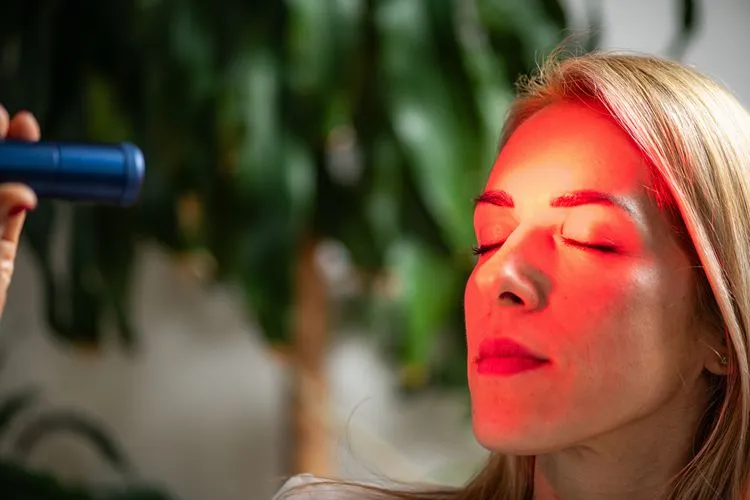
The process is called photobiomodulation. When skin cells absorb photons at specific wavelengths — particularly 633nm (red) and 830nm (near-infrared) — it triggers a cascade of cellular responses. The primary target is the mitochondria in skin fibroblast cells. Light absorption increases mitochondrial ATP production, which in turn stimulates fibroblast activity: the production of new collagen, elastin, and hyaluronic acid in the dermal matrix.
Collagen is the primary structural protein of skin and its degradation is the main driver of skin thinning, loss of firmness, and the deepening of fine lines with age. By stimulating fibroblasts to produce new collagen, red light therapy works on the same structural deficit that topical retinoids address — but through a completely different mechanism that is additive rather than redundant with a retinoid routine.
Red light (633nm) primarily acts in the epidermis and papillary dermis. Near-infrared (830nm) penetrates to the deeper reticular dermis where the bulk of structural collagen is located. The combination of both wavelengths, as used in the Omnilux Contour Face and CurrentBody Series 2 devices, provides both superficial and deep stimulation in a single session.
The Clinical Evidence — What the Research Actually Shows
The most frequently cited study for home-use LED therapy is a 2014 controlled trial by Wunsch and Matuschka published in Photomedicine and Laser Surgery. The trial assessed both red (633nm) and near-infrared (830nm) light across a treatment group, finding statistically significant improvements in skin roughness, fine line appearance, and intradermal collagen density measured by ultrasound. Participant satisfaction scores were strongly positive.
Omnilux, whose technology forms the basis of their Contour Face home device, has accumulated more than 40 peer-reviewed clinical studies across their professional and consumer device range — more than any other LED brand. These studies consistently support improvements in periorbital wrinkles, nasolabial fold depth, and overall skin quality with consistent treatment.
CurrentBody's independent clinical trial of the Series 2 device, conducted with 35 participants over 8 weeks, showed a 57% increase in skin plumpness and 27% improvement in brightness. A separate trial with 32 participants showed 30% reduction in wrinkle appearance at the 8-week mark.
It is important to note that these studies use the devices at the prescribed protocol — 10 minutes per session, three to five times per week — consistently over the study period. Occasional or infrequent use does not reproduce clinical study results.
At-Home Devices vs Professional Clinic Treatment — Understanding the Difference
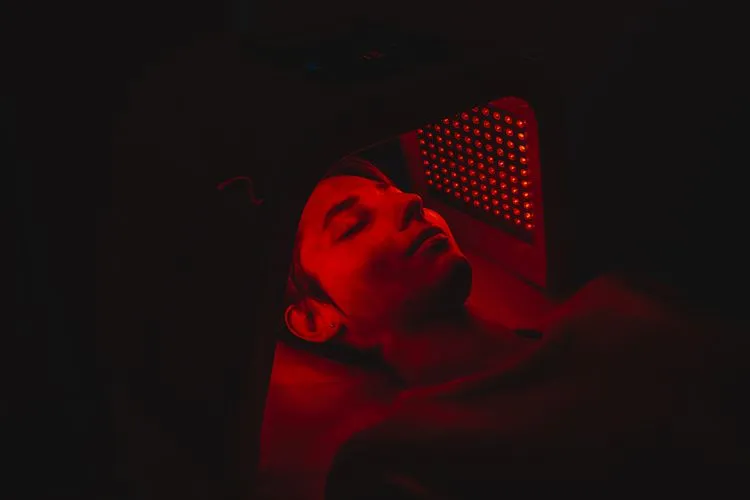
Professional LED devices used in dermatology clinics and aesthetics practices operate at higher energy outputs than home devices. The dose of light energy delivered in a 20-minute professional session is typically higher than in a consumer at-home session. However, the proximity advantage of at-home LED masks — the device sitting directly on the skin rather than held at a distance — partially compensates for the lower output.
Professional LED clinic treatments in Ireland typically cost EUR 80-150 per session and are usually recommended in courses of six to twelve sessions. An at-home device purchased for EUR 300-500 covers its cost within two to four months if used consistently, compared to ongoing clinic sessions. The trade-off is that professional treatment produces faster visible results and is supervised by a trained practitioner who can adjust protocols for individual skin concerns.
For wrinkle reduction specifically, the clinical consensus is that both professional and home-use LED therapy produce real results — the difference is the speed at which those results become visible. Professional treatment produces faster change; home-use treatment achieves similar cumulative results over a longer timeframe with consistent use.
Types of Wrinkles — What Red Light Therapy Can and Cannot Address
Fine lines from collagen loss and photoageing — red light therapy is well-evidenced for this category. The perioral lines, forehead lines with shallow depth, and overall skin texture changes associated with intrinsic ageing and sun damage respond positively to consistent LED treatment.
Dynamic wrinkles from muscle movement — red light therapy has no effect on the muscular mechanism behind expression lines. Botulinum toxin (Botox) is the appropriate treatment for dynamic expression lines. However, LED therapy can improve the skin quality around existing expression lines, making them less prominent in appearance even if the muscular component remains unchanged.
Deep static wrinkles from volume loss — significant volume loss and very deep folds (nasolabial folds, marionette lines) are primarily caused by fat pad displacement and structural changes below the dermis. Red light therapy stimulates the dermis, not the subcutaneous layers, and will not fully address deep volume-related wrinkles. Fillers or surgical interventions are the appropriate treatments for significant volume loss.
The sweet spot for red light therapy is the large middle category: fine to moderate lines associated with collagen degradation, photoageing, and skin quality changes — the most common concern for Irish women and men in their 30s, 40s, and 50s.
Combining Red Light Therapy with Other Anti-Ageing Treatments
Red light therapy is most effective as part of a layered anti-ageing approach rather than as a standalone treatment. The most well-supported combination protocols from the clinical literature:
LED therapy + retinoid: Alternating evenings of LED therapy and a retinoid (retinol, retinaldehyde, or prescription retinoid) addresses collagen stimulation through two distinct mechanisms. Do not apply retinol immediately before an LED session — complete the LED treatment on clean, bare skin, then apply your skincare routine afterwards.
LED therapy + vitamin C serum: Vitamin C (L-ascorbic acid) is a co-factor in collagen synthesis and a potent antioxidant that protects against the photoageing damage that LED therapy targets. Applied after an LED session as part of a morning routine, it supports the collagen-building response that red light initiates.
LED therapy + SPF daily: Consistent broad-spectrum SPF 30 or higher is the single most important step in preventing further photoageing while LED therapy works to repair existing damage. Without daily sun protection, new UV damage continues to degrade collagen faster than LED therapy can stimulate its production.
“Red light therapy for wrinkles has moved from speculation to established dermatology. The evidence is real, the mechanism is understood, and the devices are accessible in Ireland. What it requires is consistency.”
Ready to choose a device? Our complete buyer's guide covers the best red light therapy masks available in Ireland in 2026.
Best Red Light Therapy Mask — Ireland Buyer's GuideFrequently Asked Questions
Yes, with consistent use. Published research in peer-reviewed journals confirms that red (633nm) and near-infrared (830nm) light stimulates fibroblast collagen production and reduces measurable fine line depth. Results require consistent sessions three to five times per week over at least four to eight weeks and are most significant for fine to moderate lines rather than deep wrinkles.
The Omnilux Contour Face (available from SkinShop.ie) and CurrentBody Skin LED Light Therapy Mask Series 2 (ships to Ireland from currentbody.com) are the two most clinically supported home-use LED masks available to Irish shoppers. Both are FDA-cleared with independent clinical trial data. Omnilux has the larger clinical evidence base; CurrentBody offers more LEDs and wavelengths at a higher price.
Clinical study protocols typically run three to five sessions per week for four to six weeks as an initial course — around 20-30 sessions. Noticeable improvements in skin texture tend to appear at the four week mark; fine line reduction is more measurable at eight to twelve weeks. Maintenance sessions of two to three times weekly sustain results indefinitely.
With FDA-cleared home devices used at the recommended protocol (10 minutes per session), over-treatment is not a significant concern. Increasing session frequency above five times per week does not proportionally increase results and is unnecessary. There is no established evidence of harm from consistent correct use of home LED devices at 633nm and 830nm.
Red light therapy is most effective for fine to moderate lines caused by collagen loss and photoageing. Deep static wrinkles associated with significant volume loss or fat pad displacement are not primarily caused by collagen deficit and respond more to injectable fillers or surgical interventions. LED therapy will improve the overall skin quality around deep wrinkles but will not fully address their depth.
Beauty Shop Ireland
Beauty Shop Ireland is an independent editorial guide for Irish consumers. We research skincare brands, makeup, beauty devices, and red light therapy products available in Ireland — giving you honest, straightforward buying advice without the influencer spin.
References
- Wunsch A, Matuschka K. A controlled trial to determine the efficacy of red and near-infrared light treatment in patient satisfaction, reduction of fine lines, wrinkles, skin roughness, and intradermal collagen density increase. Photomedicine and Laser Surgery. 2014;32(2):93-100. PubMed
- Barolet D, Roberge CJ, Auger FA, Boucher A, Germain L. Regulation of skin collagen metabolism in vitro using a pulsed 660 nm LED light source: clinical correlation with a single-blinded study. Journal of Investigative Dermatology. 2009;129(12):2751-9. PubMed
- Avci P, Gupta A, Sadasivam M, et al. Low-level laser (light) therapy (LLLT) in skin: stimulating, healing, restoring. Seminars in Cutaneous Medicine and Surgery. 2013;32(1):41-52. PubMed